
Game 3 world series
There are a few ways our supporters stay involved, from membership and mission support to golf and donor experiences. The greatest moments in baseball history can’t be preserved without your help. https://gta-best.com/ Join us today.
Despite its name, the World Series remains solely the championship of the Major League Baseball teams in the United States and Canada, although MLB, its players, and North American media sometimes erroneously refer to World Series winners as “world champions of baseball”.
^ ***: Gillette, which sponsored World Series telecasts exclusively from roughly 1947 to 1965 (prior to 1966, the Series announcers were chosen by the Gillette Company along with the Commissioner of Baseball and NBC), paid for airtime on DuMont’s owned-and-operated Pittsburgh affiliate, WDTV (now KDKA-TV) to air the World Series. In the meantime, Gillette also bought airtime on ABC, CBS, and NBC. More to the point, in some cities, the World Series was broadcast on three stations at once.
Another world game
In August 1989, Chahi was impressed by the flat-color animations that the Amiga version of Dragon’s Lair had and thought that it would be possible to use vector outlines to create a similar effect using much less computer storage. After first attempting to write the graphical routines in C, he turned to assembly language. He wrote a polygon routine for the Motorola 68000 on an Atari ST to test his theory, with much success. Later, he found that he could run the code on the Amiga platform and achieve a frame rate of about 20 frames per second, later recognizing this as “a major turning point in the creation of the game” and the point where he knew the polygon approach would work. He was able to take advantage of the Amiga’s genlock capabilities to create rotoscoped animations with the polygons, using video recordings of himself performing various actions. Though he had tried to use smaller polygons (which Chahi called “pixigons”) to construct the backgrounds for the scenes based on Deluxe Paint artwork, the process of creating them was excruciatingly slow, and he returned to using bitmapped images.
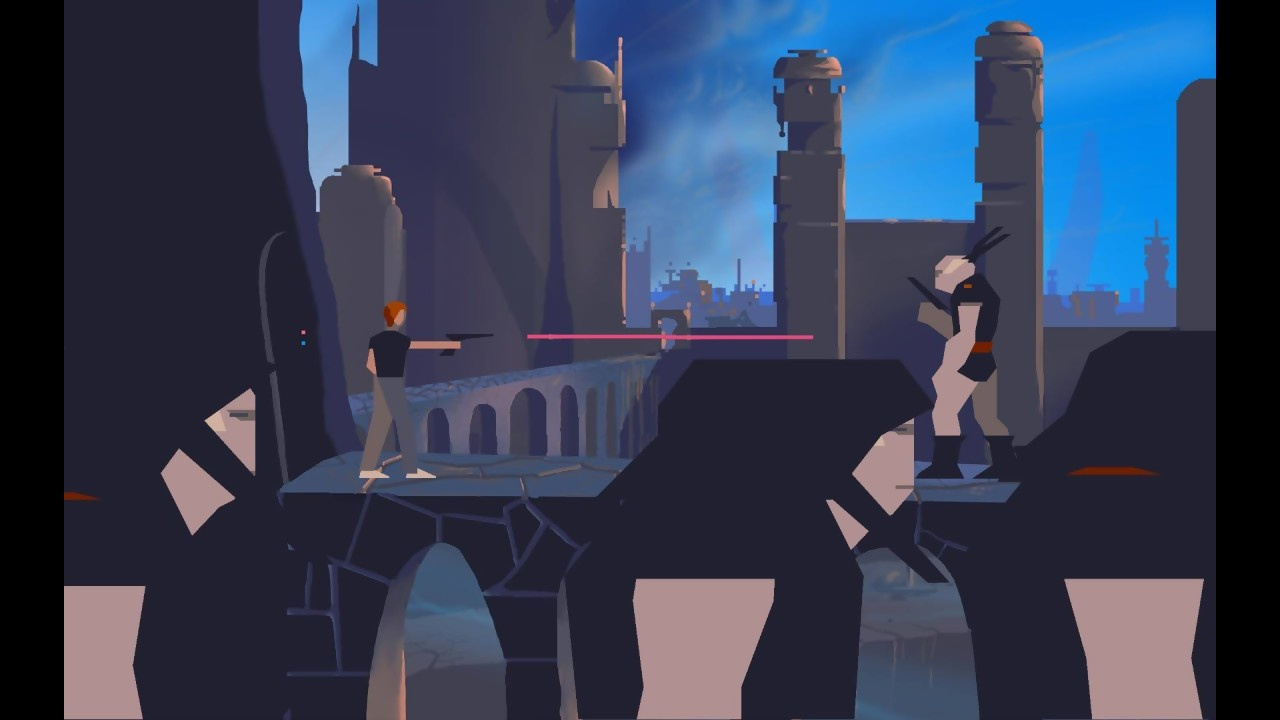
In August 1989, Chahi was impressed by the flat-color animations that the Amiga version of Dragon’s Lair had and thought that it would be possible to use vector outlines to create a similar effect using much less computer storage. After first attempting to write the graphical routines in C, he turned to assembly language. He wrote a polygon routine for the Motorola 68000 on an Atari ST to test his theory, with much success. Later, he found that he could run the code on the Amiga platform and achieve a frame rate of about 20 frames per second, later recognizing this as “a major turning point in the creation of the game” and the point where he knew the polygon approach would work. He was able to take advantage of the Amiga’s genlock capabilities to create rotoscoped animations with the polygons, using video recordings of himself performing various actions. Though he had tried to use smaller polygons (which Chahi called “pixigons”) to construct the backgrounds for the scenes based on Deluxe Paint artwork, the process of creating them was excruciatingly slow, and he returned to using bitmapped images.
With the creation of the tools needed for building out the rest of the game by December 1989, Chahi began working on the introductory sequence as a means to validate the full capacities of his engine. The introduction sequence also gave Chahi the chance to explore the types of cinematics he could create through the engine. Chahi later considered this the “first step in the improvisation process” that he used throughout the rest of development. He finished the game’s introduction sequence in early 1990 and started working on the first level. Chahi worked at the game at a linear pace, developing each section of the game in chronological order and influenced by his own personal feelings and attitude at the time. For example, as Chahi recognized he was trying to create a game on his own, the first portions of the game evoke loneliness and isolation, reflecting Chahi’s mood at the time. He did not have the original intention of the character meeting an ally, but again described the improvisation approach led him to include the alien friend, and had included specific cinematics that showed a close up of the alien to help the player imagine this world.
Another World is a cinematic platform action-adventure game designed by Éric Chahi and published by Delphine Software in November 1991. In North America it was published as Out of This World. The game tells the story of Lester, a young scientist who, as a result of an experiment gone wrong, finds himself on a dangerous alien world where he is forced to fight for his survival.
The game’s French designer Éric Chahi had previously worked as a game programmer and then as a graphic designer for video games since 1983. It was the success of his earlier work with Paul Cuisset as a graphic designer for the adventure game Future Wars for Delphine Software and its royalties that gave him the chance to develop Another World “without any constraint of any sort or any editorial pressure.” After Future Wars was released in 1989, Chahi had the choice either to work on Cuisset’s next game, Operation Stealth, or create his own game. As “there had been many books and tools released to develop easily on the Amiga at that time,” Chahi felt confident that he could go back to programming.
Chahi acquired the rights to Another World’s intellectual property from Delphine Software International after they closed down in July 2004. Magic Productions then offered to port the game to mobile phones, and it was ported with help from Cyril Cogordan. Chahi saw that the game’s playability could be improved, so he used his old Amiga for reprogramming certain parts of the script and made the graphics’ shading clearer in order to counter mobile phones’ low resolutions. In July 2005, almost a decade and a half after it was first released on the Amiga, the game was released for mobile phone handsets using the Symbian operating system, thanks to Telcogames and developer Magic Productions. In 2006, Magic Productions also released a remastered Pocket PC version for Windows Mobile 5.0 OS or later in QVGA (320×240 resolution). Telcogames entered administration in 2008, closing the Magic Productions studio. The administrator’s letter to stakeholders mentions that its assets will be sold, but does not indicate to whom or mention Another World assets by name.
World series game 3
The Yankees are up against it now. Only 15 teams in 92 tries have won a best-of-seven postseason series in which they dropped the first two games. And so, as their Game 3 starter Clarke Schmidt takes the ball opposite the Dodgers’ Walker Buehler, they’re going to need to feed off the energy of a hungry crowd that hasn’t seen a World Series home game in the Bronx since the Yanks’ 2009 title run.
Sparked by – stop us if you’ve heard this one – a Freddie Freeman home run and steered by an exceptional outing from Walker Buehler, the Dodgers’ 4-2 triumph over the Yankees in Game 3 on Monday night put them on the verge of a World Series sweep.
Who are the starting pitchers?Dodgers: RHP Walker Buehler (1-6, 5.38 ERA in the regular season)Buehler’s regular season didn’t go as expected once he returned from a second Tommy John surgery, but the right-hander has had a strong postseason for the Dodgers. Buehler’s final line against the Padres in NLDS Game 3 looks worse than his overall performance. He then bounced back in a pivotal Game 3 in the NLCS, tossing four scoreless innings against the Mets.
2) Is Freddie Freeman going to homer again?If the Dodgers do end up winning this series — as is still pretty likely, considering they’re up 3-1 — Freeman is obviously going to be the MVP. His two-run shot in the first inning of Game 4 marked his sixth consecutive World Series game with a home run (going back to 2021 with Atlanta), which is of course the all-time record.
When the game 3 of the world series
Los Angeles rallied back from an early hole to beat the New York Yankees 7-6 in Game 5 at Yankee Stadium, accomplishing one more piece of history with the biggest comeback to clinch a World Series in baseball history.
Yankees: RHP Clarke Schmidt (5-5, 2.85 ERA in the regular season)Schmidt will make his third career postseason start and his first in the World Series. He tossed 4 2/3 innings of two-run ball in each of his first two outings this October, taking no-decisions against the Royals and Guardians. Schmidt pitched to a 4.50 ERA in eight home starts during the regular season, compared to a 1.39 ERA in eight road outings.
Dodgers manager Dave Roberts told ESPN on Sunday that Ohtani was in good shape and “will be playing in game 3 tomorrow,” according to reporter Karl Ravech. The Japanese two-way player gave fans a fright when he slide hard trying to steal second base in the bottom of the seventh.
The Yankees reclaimed the lead 6-5 in the sixth on Stanton’s sacrifice fly, but a pair of sacrifice flies from second baseman Gavin Lux and right fielder Mookie Betts gave the Dodgers their first lead of the game at 7-6 in the top of the eighth.
The Yankees are up against it now. Only 15 teams in 92 tries have won a best-of-seven postseason series in which they dropped the first two games. And so, as their Game 3 starter Clarke Schmidt takes the ball opposite the Dodgers’ Walker Buehler, they’re going to need to feed off the energy of a hungry crowd that hasn’t seen a World Series home game in the Bronx since the Yanks’ 2009 title run.